
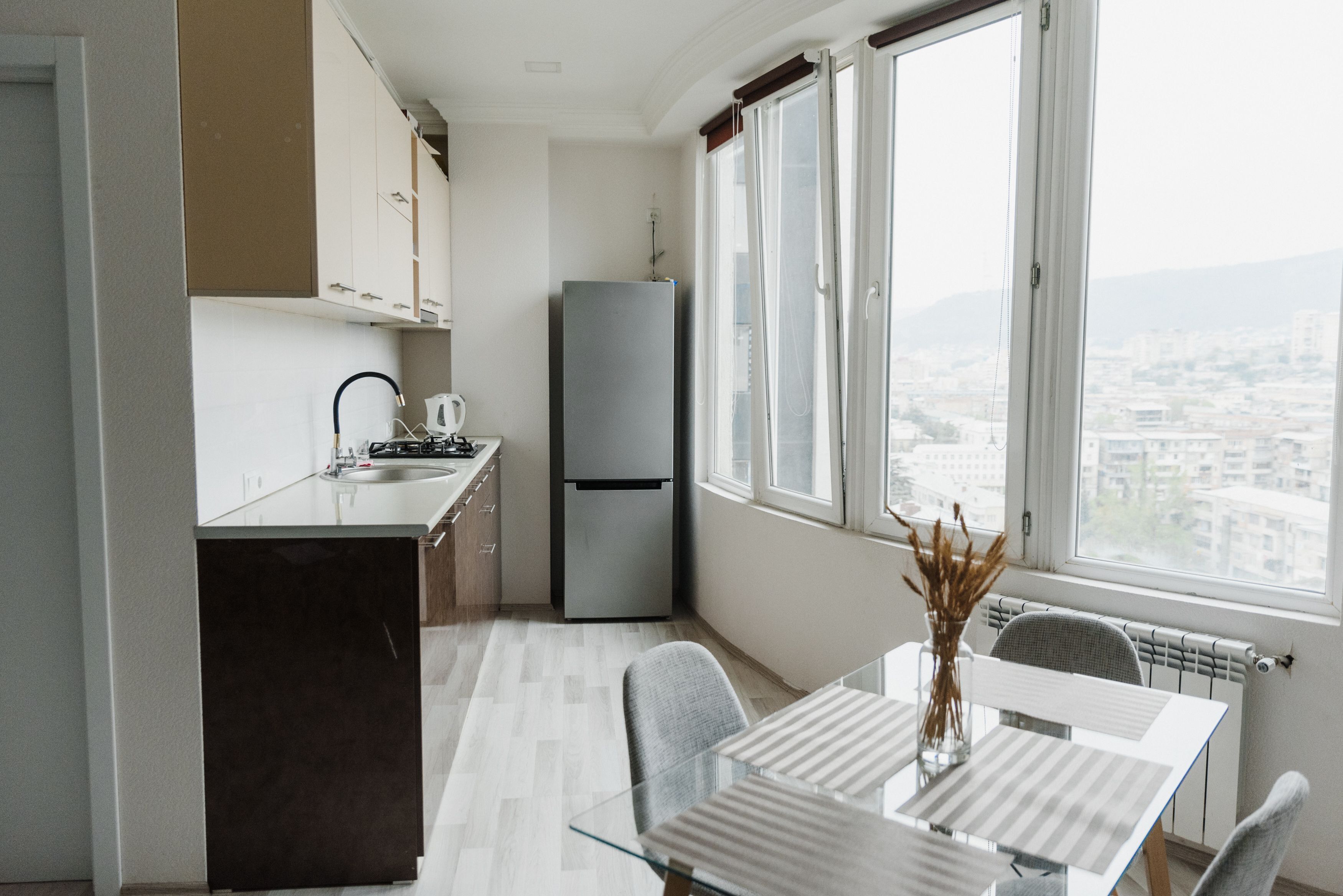
Quick Answer: The small-space appliances worth buying for a studio apartment are the ones that replace something bigger: a countertop oven, a compact microwave, and a mini fridge only if you need extra cold storage. A portable dishwasher or ventless dryer makes sense when your lease and your outlets allow it.
A studio kitchen gives you a few feet of counter and a handful of outlets. Every appliance you bring in has to justify the space it takes. This guide is written for renters across the USA and for residents of our studio apartments in New Braunfels, where summer heat makes a cooler way to cook a real advantage.
Buy less than you think you need. You can always add one more later.
What to Look For in Studio Appliances
Good studio appliances do two jobs, fit the counter you already have, and run safely on a standard wall outlet. Check the yellow EnergyGuide label for yearly running cost, measure the spot before you order, and read your lease for any rules on laundry or dishwashing equipment. If an appliance fails one of those checks, leave it on the shelf.
Measure First, Then Shop for Compact Appliances
Depth is the number people forget. A unit that fits the width of your counter can still block a cabinet door or hang over the edge. Measure width, depth and the height under your upper cabinets, then leave a few inches around anything that vents heat. Compact appliances are sold by capacity, so compare the outside dimensions too.
Know What Your Outlets Can Handle
The U.S. Fire Administration advises plugging only one heat-producing appliance into a wall outlet at a time, and never running one from an extension cord. In a studio that usually means the coffee maker and the toaster oven take turns. It's a small habit, and it matters more when your kitchen and your bed share a room.
Which Small Appliances Earn Their Counter Space?
The small appliances that earn a spot are the ones you'd use at least three times a week. For most studio renters that means one cooking appliance, one reheating appliance, and maybe extra cold storage. Start by checking what each studio floor plan already includes, so you don't pay for a duplicate.
Countertop Oven vs. Compact Microwave
These two do different work. According to the U.S. Department of Energy, a toaster or convection oven uses one-third to one-half as much energy as a full-sized oven, which makes a countertop oven the better pick for roasting vegetables or baking for one. It also puts far less heat into a single room.
A compact microwave wins on reheating. ENERGY STAR notes that microwaves can use up to 80% less energy than a conventional oven, and that there's no ENERGY STAR category for them because models perform about the same. So shop on size and wattage, and skip the premium features.
When a Mini Fridge Makes Sense
ENERGY STAR defines a compact refrigerator as anything under 7.75 cubic feet, and certified models must use 10% less energy than the federal minimum. If your studio already has a refrigerator, a mini fridge is only worth it for a specific need, like drinks beside a desk or overflow for meal prep. Otherwise it's a second appliance running all day and all night.
| Appliance | Best for | Efficiency point | Skip it if |
|---|---|---|---|
| Countertop oven | Baking and roasting for one or two | One-third to one-half the energy of a full-sized oven (DOE) | You mostly reheat |
| Compact microwave | Reheating and quick meals | Up to 80% less energy than a conventional oven (ENERGY STAR) | Your unit already has one |
| Mini fridge | Extra cold storage | Certified models use 10% less than the federal minimum | Your main refrigerator is rarely full |
| Compact dishwasher | Daily cooking at home | Certified models use 2.0 gallons or less per cycle | You can't fill it before running it |
| Ventless dryer | Units with laundry hookups and no vent | Heat pump models use about 70% less energy | Your lease doesn't permit one |
Is a Portable Dishwasher or a Ventless Dryer Worth It?
Both are worth it for the right renter, and both need a yes from your leasing office first. A portable dishwasher suits someone who cooks most nights and has a faucet it can connect to. A ventless dryer only works where there's a laundry hookup and the right electrical supply. Ask before you buy, because returns on large appliances are a hassle.
How a Compact Dishwasher Compares to Hand Washing
ENERGY STAR classes a compact dishwasher as one that holds fewer than eight place settings plus six serving pieces. Under the criteria in effect since July 19, 2023, certified compact models must use no more than 155 kWh a year and 2.0 gallons per cycle. That's very little water next to a running tap.
There's a catch, though. ENERGY STAR also points out that compact models may use more energy than standard ones over time because they hold less, and that a dishwasher uses about the same energy whether it's full or half empty. Run it full or don't run it.
What a Ventless Dryer Needs From Your Space
Heat pump dryers recycle warm air in a closed loop, so they don't need a vent to the outside. ENERGY STAR reports that certified heat pump models use around 70% less energy than conventional dryers, with typical dry times of 37 to 70 minutes. The tradeoff is price. They cost more upfront, and some compact models need a 240-volt outlet that a studio may not have.
Does your community already offer what you're about to buy? Look through the community amenities at Gruene Pointe before you spend money on something you won't need at home.
Frequently Asked Questions
1. What appliances do you need in a studio apartment?
Most studio renters need a way to cook, a way to reheat, and cold storage. If your unit supplies a refrigerator and a cooktop, a compact microwave or a countertop oven usually covers the rest. Add a kettle or coffee maker if you use one daily. Anything beyond that should replace a trip or a chore you already do.
2. Can you use a portable dishwasher in a rental?
Often yes, but check your lease first. Portable and countertop models connect to a kitchen faucet and drain into the sink, so they don't change the plumbing. Some communities still restrict them. Ask your leasing office in writing, and confirm your faucet accepts the adapter before you order one.
3. Is a toaster oven or a microwave better for a small kitchen?
It depends on how you eat. A microwave is faster and uses less energy for leftovers and frozen meals. A toaster oven browns and crisps, which a microwave can't do. If you only have room for one, pick the appliance that matches the meals you make most weeks, not the one with more settings.
4. How do you choose appliances for a very small kitchen?
- Measure width, depth and cabinet clearance before you shop.
- Pick appliances that do two jobs, like an oven that also toasts.
- Compare the yearly cost on the EnergyGuide label.
- Plan one heat-producing appliance per outlet.
5. Do ventless dryers work as well as vented dryers?
Modern heat pump models dry a load in roughly 37 to 70 minutes, according to ENERGY STAR, which is close to a conventional dryer. They run at lower temperatures and collect water in a tank or drain line instead of venting it. Expect to clean the lint filter every load and empty the tank if there's no drain.
Conclusion
Every appliance in a studio should earn the counter it sits on. Measure first, check your lease, and buy for the way you cook on an ordinary Tuesday. For renters in New Braunfels, where a full-sized oven heats the whole room by July, the small-space appliances worth buying for a studio apartment are usually the ones that keep the kitchen cooler and the counter clear.