
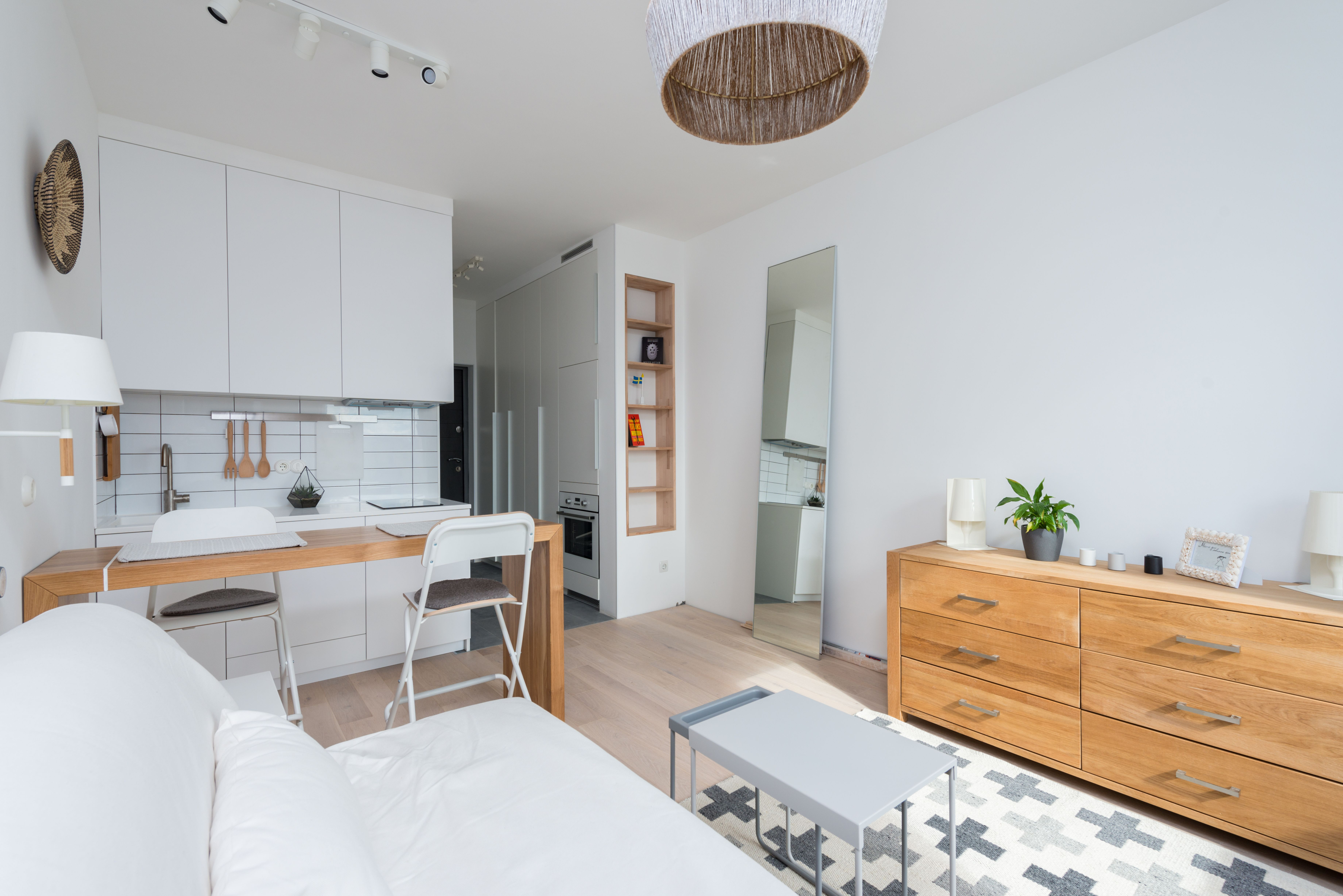
Quick Answer: How to make a small studio feel bigger comes down to four reversible moves: push light onto the walls instead of only down from the ceiling, hang one large mirror across from your window, lift storage off the floor, and use rugs to mark where one zone ends and the next starts. No paint, no drill, no deposit risk.
A studio is one room doing four jobs at once. Learning how to make a small studio feel bigger has less to do with buying furniture than with where the light lands and how much floor stays visible. Nothing below needs a repainted wall or a contractor, and all of it works in a compact unit like the studio and one-bedroom floor plans at Compass Flats in New Braunfels.
What actually makes a small studio feel bigger
Two things drive how large a room reads. The first is how much uninterrupted floor your eye can see. The second is how evenly light reaches the walls, because a room lit only from the middle of the ceiling drops its corners into shadow and looks smaller than the tape measure says. Square footage barely moves by comparison.
Numbers set expectations. RentCafe's May 2026 analysis of Yardi data puts the average U.S. studio at 460 square feet, while a March 2026 breakdown built on Census Bureau American Housing Survey data lands at 440. Averages shift with the provider and with what each one counts as a studio, so treat any single figure as a ballpark. For scale, the Census Bureau's 2025 Characteristics of New Housing, published July 2026, counted 484,000 multifamily units completed at a median 1,000 square feet for units built for rent.
How to make a room look bigger without touching the paint
Paint is the first thing renters reach for and the thing most leases restrict. Skip it. Start with the window instead: mount the curtain rod within a few inches of the ceiling and let the panels just graze the floor. The eye reads the whole wall as window, and the ceiling feels higher.
Then the mirror. One large piece across from the window beats four small ones scattered around, because it repeats the daylight instead of chopping it up. Leaning a full-length mirror avoids hardware entirely, though anything tall enough to tip still needs securing.
Furniture on visible legs is the trick people skip. A sofa with six inches of open floor underneath keeps the floor line unbroken wall to wall. A skirted sofa stops it dead.
Lighting is where federal building guidance and interior designers agree. The U.S. General Services Administration recommends layers of light rather than a single source, and notes that accent light on walls prevents the shadows that make a space look enclosed. Translated to a studio: a floor lamp pointed into a corner and a table lamp at the far end, both with LED bulbs, will do more than any furniture purchase.
Which renter-friendly tricks are worth the effort?
Not every idea on Pinterest survives contact with a lease. Sorting the advice on how to make a small studio feel bigger by cost and move-out risk gets you to the short list below.
| Change | What it does | Move-out risk | Rough cost |
|---|---|---|---|
| Second and third light source | Removes corner shadow, widens the room visually | None | $30 to $90 |
| Large mirror facing the window | Repeats daylight, reads as a second window | None if leaned and secured | $40 to $150 |
| Curtain rod raised near the ceiling | Lifts the perceived ceiling height | Two small holes, patchable | $20 to $60 |
| Two zone rugs instead of one | Splits one room into sleeping and living areas | None | $60 to $200 |
| Under-bed and over-door storage | Clears counters and floor, the biggest visual win | None | $25 to $80 |
| Best first weekend: lights, mirror, declutter | Most perceived space per dollar spent | None | Under $150 |
Apt decorating tips that keep your deposit intact
Adhesive strips are the renter's default, and they fail in predictable ways. Wipe the wall with rubbing alcohol first, test one strip on a hidden patch, then pull the release tab straight down and slowly at move-out. Fresh paint is the usual culprit behind torn drywall, so leave a newly painted wall alone for a month.
Anything tall gets anchored, including that leaning mirror and any bookcase you use for vertical storage. The CPSC's Anchor It! campaign makes the renter case directly: patching the wall after an anchor comes out takes minutes. In older buildings there is one more rule. EPA guidance for renters in pre-1978 housing warns that sanding, scraping, or cutting painted surfaces can release lead dust, so leave that work to your property manager.
How to decorate a small apartment that is one single room
Zoning is the whole answer. You are drawing rooms that do not exist by changing what is underfoot and what sits at eye level, so the space stops reading as one box with a bed in it. Good design for small apartment living starts on the floor, not on the walls.
Small apartment decorating, zone by zone
Put the bed against a wall rather than floating it, ideally the wall farthest from the door. A bed you walk past on entry makes the unit feel like a bedroom with a kitchen attached. Then give it a boundary: a rug that runs under the bed and stops, or a low console at the foot.
The work zone is where most renters overbuy. A desk deeper than 20 inches eats floor you cannot spare, and a 40-inch writing desk handles a laptop and monitor fine. Better yet, move the job out of the unit. The coworking space and game room at Compass Flats are the cheapest square footage you will ever add.
Eating is the easiest zone to solve. A drop-leaf table against the wall or two counter stools at the kitchen peninsula beat a four-seat dining set nobody uses. Most interior design for small apartment renters comes down to two decisions: where the bed goes, and what you refuse to buy.
One caution on dividers. A solid screen chops the room in half and blocks the daylight you just worked to spread around. An open-back shelf or a curtain on a tension rod does the same job without killing the light. Check the community photo gallery before you shop, since window placement changes what fits.
Frequently Asked Questions
1. How to make small spaces look bigger on a small budget?
Spend one weekend on these four moves before buying anything:
- Clear every flat surface you can see from the door
- Add a floor lamp and a table lamp so light hits the walls
- Hang or lean one large mirror opposite the window
- Move the curtain rod up near the ceiling line
2. Do dark walls make a studio look smaller?
Not automatically. Light colors bounce more light around a room, which helps in a unit with one window, but a dark wall with strong lamp coverage can read as depth instead of closeness. Since most leases restrict painting anyway, the question matters less for renters than for owners.
3. How big is the average studio apartment in the U.S.?
Roughly 440 to 470 square feet, depending on whose data you read. RentCafe put the national average at 460 square feet in May 2026, while an American Housing Survey analysis published in March 2026 came in at 440. Individual units in any market vary widely from either figure.
4. Should I use a room divider in a studio?
Only if it lets light through. Open shelving, a curtain on a tension rod, or the back of a low sofa all separate zones without walling off the window. Check your lease before mounting a ceiling track, and ask the leasing office in writing rather than assuming approval.
5. What furniture should I skip in a studio?
Deep sectionals, oversized headboards, and bookcases more than 12 inches deep take back the floor you are trying to reveal. Skirted upholstery hides the floor line too. Measure your unit before ordering anything, and tape the footprint onto the floor so you can walk around it first.
The takeaway
How to make a small studio feel bigger is a light and floor problem, not a square footage problem. Get light onto the walls, keep the floor visible under your furniture, hang one large mirror where it can repeat the daylight, and let rugs do the work of walls. Every one of those comes out when you move, which is the point. Layout helps too, so take a look at what Compass Flats has available before assuming you need more square feet.