
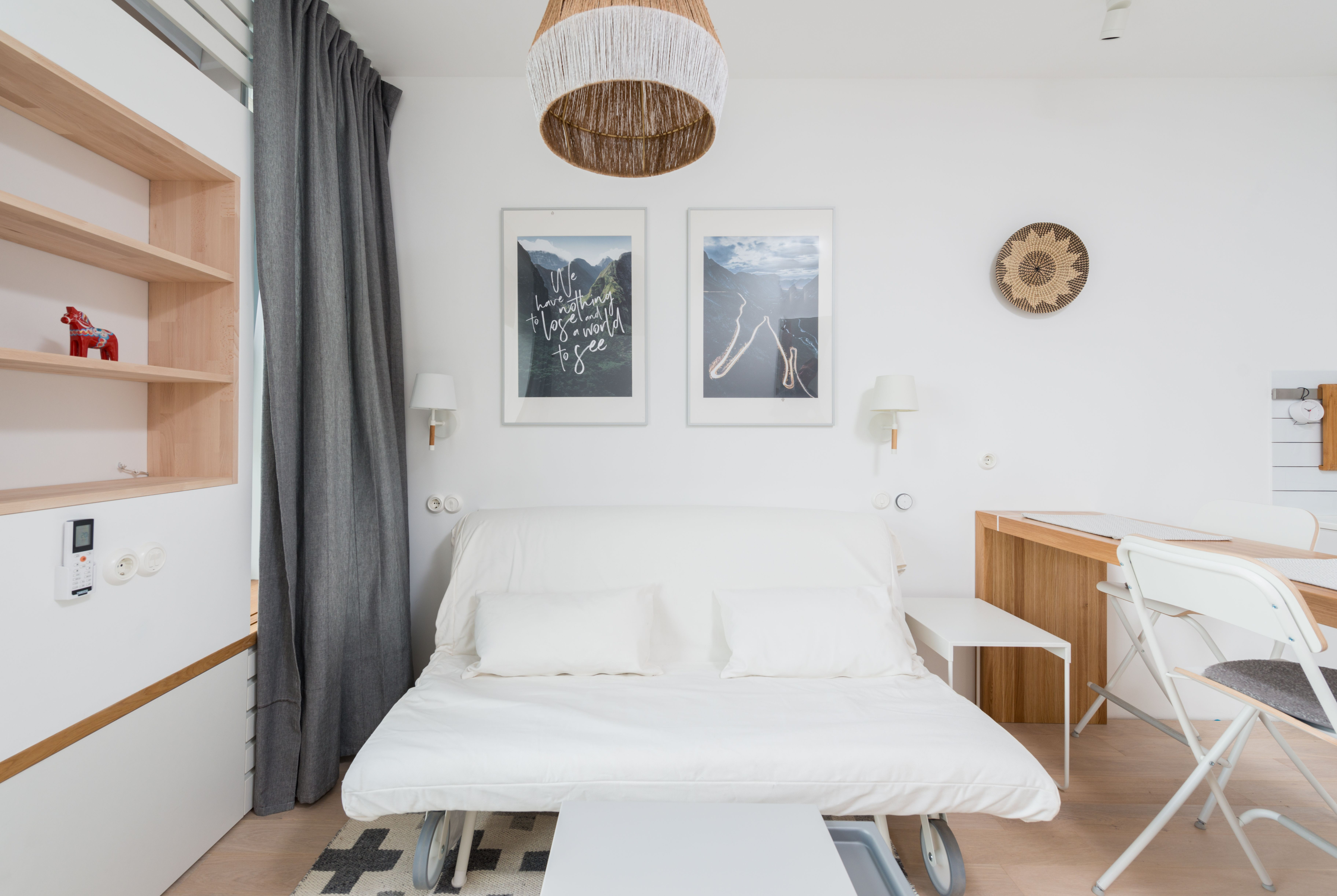
Quick Answer: Do studio apartments actually save you money? Usually yes, though less than most renters expect. In the San Antonio-New Braunfels metro, HUD's FY2026 Fair Market Rent is $1,077 for a studio and $1,177 for a one-bedroom, a $100 monthly gap. Lower power use and less furniture widen it. Storage fees and takeout can erase it.
A studio is usually the lowest-priced way to live alone, but the advertised rent is only one line of the math. Gruene Pointe is an all-studio community, with studio apartments off I-35 in New Braunfels, so we'd rather show the numbers than ask you to take our word for it. The cost data below comes from federal sources.
What to look for in studio apartment cost
Compare the full monthly cost, not the advertised rent. Studio apartment cost has four parts: base rent, utilities, upfront furnishing, and the extras a small space pushes you to buy somewhere else. A studio wins on the first three almost every time. The fourth decides whether the savings last past the first few months.
Studio vs 1 bedroom: the rent gap
HUD publishes Fair Market Rents every year for each metro area. They estimate gross rent, meaning rent plus basic utilities, at the 40th percentile of what recent movers pay. For FY2026, the San Antonio-New Braunfels figure was $1,077 for an efficiency and $1,177 for a one-bedroom. That's $100 a month, or $1,200 a year.
Smaller than you expected? It usually is. A studio still has a full kitchen and a full bathroom. What it drops is a wall and a bedroom's worth of floor, which is why the discount is modest.
Utilities and the apartment budget
Electricity is where small flats, as British renters call compact apartments, pull ahead. The U.S. Energy Information Administration put the average Texas residential electric bill at $163.72 a month in 2024, on 1,096 kWh of use. That average is mostly houses. In its 2015 household energy survey, the agency found that people in single-family detached homes used nearly three times as much energy as people in apartment buildings with five or more units. Shared walls act as insulation.
The apartments in that survey averaged 924 square feet. A 400-square-foot studio has less than half of that to cool through a Texas summer.
One more thing to check. If utilities are folded into the rent, your apartment budget stops moving with the weather. Ask which utilities are covered and whether there's a usage cap.
How much cheaper is a studio than a one-bedroom?
About 8.5% cheaper on rent and basic utilities combined in the San Antonio-New Braunfels metro, going by HUD's FY2026 Fair Market Rents. That's $1,200 over a 12-month lease. The gap matters even more when you apply, because the income needed to keep housing at 30% of pay falls by $4,000.
| Cost measure | Studio | One-bedroom | Difference |
|---|---|---|---|
| HUD Fair Market Rent, per month (FY2026) | $1,077 | $1,177 | $100 |
| Same rent over 12 months | $12,924 | $14,124 | $1,200 |
| Yearly income that keeps rent at 30% of pay | $43,080 | $47,080 | $4,000 |
Source: HUD Fair Market Rents, San Antonio-New Braunfels, TX HUD Metro FMR Area. These are benchmarks, not quotes. Listings near you can sit above or below them, and HUD resets the figures every October.
Housing is the biggest line in the cost of living. The Bureau of Labor Statistics reports that it took 33.4% of average household spending in 2024, or $2,189 a month. The Census Bureau put median gross rent at $1,487 in 2024, with renters putting a median 31% of income toward it. A cut to your largest expense is worth more than the same percentage off anything else.
For a local reference point, Gruene Pointe has four studio layouts from 350 to 400 square feet. As of October 2026 they were listed from $815 to $989 a month, with major utilities and internet in the same payment. Pricing changes, so check the studio floor plans and current rates and confirm what your lease covers.
When does studio living stop saving money?
Studio living stops saving money when the small space pushes your spending somewhere else. The usual culprits are a storage unit, a coworking membership, more restaurant meals, and a second move when you outgrow the place inside a year. Any one of them can swallow a $100 monthly gap on its own.
The pros living in a studio brings are real, and not all of them show up on the lease:
- There's less to furnish. One room needs a bed, a table, and somewhere to sit.
- Power use is lower, for the reasons the EIA data shows.
- The income needed to qualify is lower.
- There's nowhere to pile up things you don't need, so you buy less.
Now the honest tradeoffs. You typically pay more per square foot in a studio than in a larger unit. And the savings belong to one person: two people splitting a $1,177 one-bedroom pay $588.50 each, well under the cost of a studio alone.
What the building offers changes the math too. A community with a co-working space, fitness center, pool, and laundry facility covers things a studio renter might otherwise pay for off-site.
Frequently asked questions
1. Are studios the most affordable apartments for one person?
Usually. Among apartments you rent alone, the studio is typically the lowest-priced layout in a given building. HUD's FY2026 benchmark for the San Antonio-New Braunfels metro is $100 a month lower for a studio than a one-bedroom. A roommate share can cost less per person, but then you aren't living alone.
2. What apartment budget do I need for a studio?
HUD treats a household as cost-burdened when housing takes more than 30% of income. At the $1,077 benchmark, staying under that line takes about $43,080 a year, or $3,590 a month before taxes. If utilities are billed separately from rent, add them to the rent figure before you run the 30% test.
3. Are cheap apartments always studios?
No. Older one-bedrooms and roommate shares sometimes cost less. Before you call any listing cheap, compare these:
- Monthly rent plus every utility you'd pay yourself
- Internet, parking, and pet fees
- Deposits and application or admin charges
- Commute costs from that address
4. Does a studio lower your cost of living?
It lowers the housing share, which is the largest one. Renters nationally put a median 31% of income toward gross rent in 2024, according to the Census Bureau. A studio trims rent and power use. It does nothing for groceries, insurance, or your car payment, so the overall drop is smaller than the rent drop.
5. Is a studio worth it for a couple?
On cost alone, rarely. Two people sharing a one-bedroom at the $1,177 benchmark pay $588.50 each, while a studio split two ways saves each of them only $50 a month more. Most couples find the extra room and the closing door are worth that. A studio makes the most financial sense for one person.
The bottom line on studio savings
The rent gap is real but modest: $100 a month at the federal benchmark for this metro, plus lower power bills and less to furnish. The savings hold when you use the space you have and lean on shared amenities instead of paying for extras elsewhere. They disappear if a storage unit or a second move enters the picture. So, do studio apartments actually save you money? For a renter living alone in New Braunfels, yes, as long as you count every line and not only the rent.